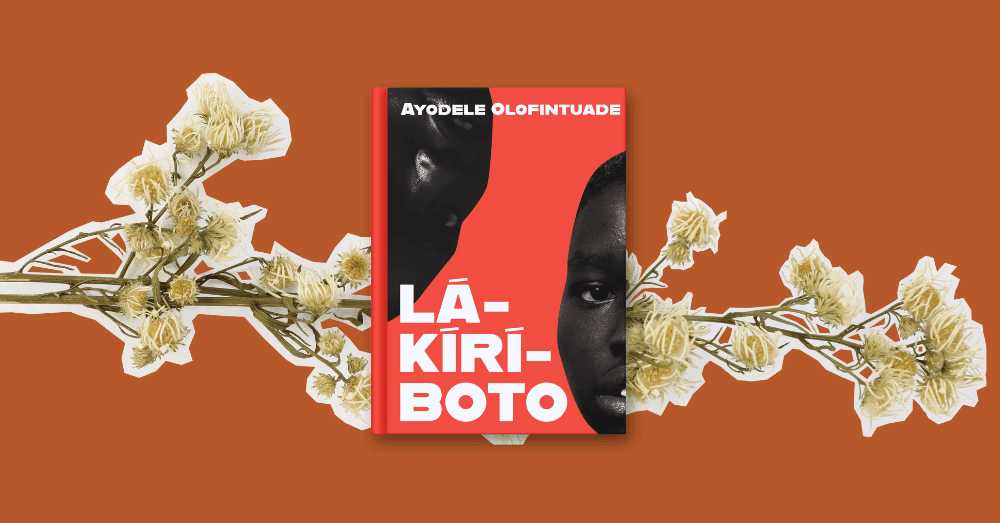

Most book reviews do not begin with a description of the book’s cover but allow me to make an exception with Lákíríboto. With its bright red background, white lettering, and pictures of two faces on either side, the moment I saw Lákíríboto in the bookstore, I knew that I would have to read it. This was my introduction to the captivating work of non-binary, Black feminist author, Ayodele Olofintuade. In this novel, Olofintuade weaves a powerful and poignant narrative that explores the complexities of family, tradition, and the struggle for independence in the face of oppressive patriarchal norms.
The author uses the foreword to set the scene for the events of the novel, describing the concept of Lákíríboto and providing a well-informed, brief insight into Yoruba culture. One of the ideas Olofintuade posits in the foreword that resonated with me the most, is that ‘labels are not used for restriction—they are used for individual freedom, because the more aligned each person is with their original purpose on earth, the healthier society is.’ The idea of finding purpose is one that they return to throughout Lákíríboto, and they demonstrate the difficulty that one may have in doing so when their society has differing expectations.
UNVEILING THE FEMININE POWER IN THE NOVEL
What makes this Lákíríboto truly compelling is Olofintuade’s skilful portrayal of the female characters—Moremi, Kudirat, Tola, and the enigmatic Morieba. Each woman is a vivid, multifaceted individual, fighting against societal constraints and personal tragedies. Their resilience and determination form the beating heart of the story, illuminating the strength that can emerge from the depths of despair.
Olofintuade delves into the harsh realities faced by these women, exposing the injustices and hardships of their lives while also highlighting the deep bond of sisterhood that develops among them. The camaraderie and mutual support they offer one another become a source of hope and inspiration amid their struggles.
The author’s decision to have the two protagonists, Moremi and Kudirat, allows them to explore two different reactions to loss and change. Moremi dreads the fact that she must join a new family and has lost the status she enjoyed when she was under the care of her grandmother. Kudirat, on the other hand, is excited to leave her village and go to live in Lagos, a place she regards as ‘The most beautiful place in the world…filled with shiny things and shiny people.’
The narrative’s exploration of queer identity through Morieba adds another layer of depth to the story, challenging traditional notions of gender and sexuality within the confines of a conservative society. This inclusion is handled with sensitivity and grace, contributing to the novel’s overall message of acceptance and self-discovery. She is a fiercely independent, confident, force of nature who wants to take custody of both Moremi and Kudirat, but she is repeatedly denied by the head of the family—Uncle Olori Ebi. It is in the dramatization of the dynamic and combative encounters between Morieba and Olori Ebi that Olufintuade’s prose shines.
Comments
Sign in to comment.