Editor’s note: This essay is available in our print issue,
The Age of Afrobeats. Buy the issue
here.
Twenty-two days into 2021, Mavin Records unearthed its then-latest gem. Announced with a self-titled EP as the label’s current generation of signees often were, Ayra Starr’s quality was distinct—that was evident early on. For observers of popular music, attuned to its implicit motivations and overarching trajectories, she was a descendant of a tradition that had its roots firmly embedded, but sometimes neglected, in Nigerian music: that of the conscious femme star. It had started in the 1980s with the likes of Onyeka Onwenu and Evi Edna Ogoli, whose shimmering songs considered from their own unique angles, what it meant to be a woman in Nigeria. The turn of the 2000s saw that vision translate into the high art of Asa’s music, where gutsy poetry blended with jazz and soul. Emerging later that decade were Tiwa Savage, Yemi Alade and Simi, although Tiwa Savage’s pop credentials and affiliation with Don Jazzy made Tiwa Savage most heralded as a direct predecessor to Ayra Starr’s own vision. But Ayra Starr had bigger plans; she wasn’t just cut from the cloth of musical greatness, she was intent on fashioning her own garment.
And she did. With just five songs which totalled under 14 minutes, that debut EP showcased Ayra Starr’s knack for creating well-realized pop music. The writing could sometimes be overly saccharine, but the project was immersive and its lead single ‘Away’ bloomed with the defining theme of a young woman’s search for intentional love. The chorus made an experiential art of the word, ‘Away’, working its second syllable to capture the fleeting emotion of the other person leaving, a-way. ‘Sare’ blended boisterous overtones of the country’s contemporary sound with the chants of Yoruba spirituals and sampled
Lijadu Sisters for further effect. Critics were
in love, listeners, too—coloured into Ayra Starr’s music was an effervescent personality that seemed at ease with the weight of musical history it carried and likewise each interview she granted purposefully revealed interesting slices of her life’s journey up to that point.
If Ayra Starr made an impressionable entry with that eponymous project and established the touchstones for where she could go musically, those motivations came full circle on 19 & Dangerous, released in August 2021, and which became one of the most definitive debut albums in the history of contemporary Nigerian pop. Where that sounds outlandish on first read, one must consider the breadth of the success the album was able to garner; critical reception, commercial might, visual coherence, perfect timing. Especially the timing: which, coming just eight months after Ayra Starr, few people would have expected the musician to release a lengthier project and even fewer people would have guessed at an album. As Afropop matures conceptually, albums have come to mean a lot more than they used to; with the right promotional tactics, anyone can finesse a successful single, but the album is a different beast, demanding sonic and thematic coherence while rewarding a variance of perspective. Essentially, a good album is made up of songs but it demands more than the interiority of songs to make a lasting impression; the album needs to flow on the exterior scale and know the nature of its ideology.
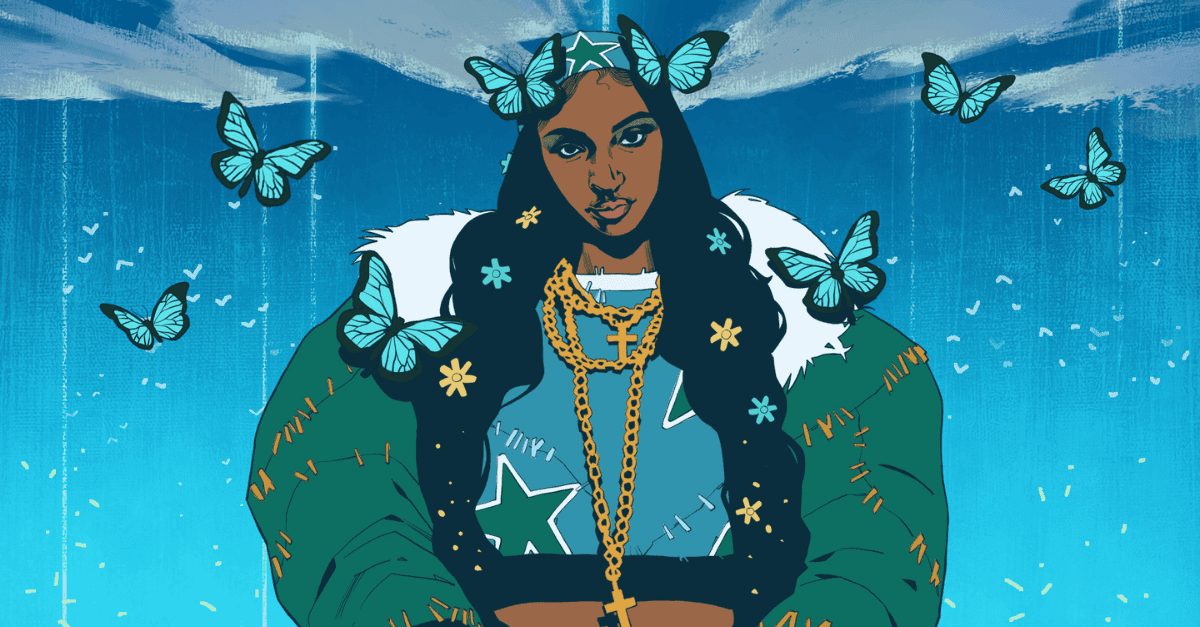
Let me explain: at first glance, 19 & Dangerous demands you take it seriously. The album cover features Ayra Starr in a colourful, hipster setting, full of eccentric wall clippings, butterflies and human figures. Seated on a sofa, her gaze is confident but vulnerable, inviting the viewer to probe the stories hidden behind its intensity. That purposefulness enters the sound, right from the first record ‘Cast,’ which she tellingly subtitled a Gen-Z anthem. Why was it important to start this seminal album with that song? Well, for a generation of young Nigerians, shame was one of the touchstones of their upbringing. Raised on the philosophy that it takes a village to raise a child, many parents subconsciously taught their children to view themselves in the third person, to always consider the opinions of others when making decisions. It’s not an inherently bad perspective, but it has been more suffocating than instructive, especially when one considers how trauma manifests in contemporary Nigerian society. ‘Cast’ in this context is a Pidgin English-supplied term which refers to shame, to the denigration of one’s image in the eyes of others. So when Ayra Starr sings ‘If I cast, I cast,’ it’s a reclamation of that quirky-but-oppressive language, setting the chest-thumping self-belief that the album would go on to embody.
International magazines like
Teen Vogue have championed Ayra Starr a Gen-Z icon, a sentiment which carries the sensationalism familiar with Western platforms although in this case, it is totally understandable. ‘I have wanted to be a superstar since I was 16,’ she shared in
an interview with
Glamour, revealing her early vision. ‘That’s always my plan. So when I wasn’t a superstar at 16, I was like “Damn, I’m never going to do this. This is not going to work”. But here I am now, so it’s fine’. For an often toxic, hyper-masculine industry like music, being so talented and so young was always going to be a considerable struggle, but
19 & Dangerous demonstrated that Ayra Starr had the wisdom to not just stay afloat on its seas, but also to fly the flag of her sojourner’s ship.
Self-expression was the album’s ethos. It had two major features: expressing the comfort she felt in her own body and that which she felt with others, which often extended into espousing her romantic philosophy. Sometimes both intermingled, as in the lead single ‘Bloody Samaritan’ where she used charged language to respond to ‘vibe killers,’ a simple but efficient phrase only a teenager could have come up with. That record’s success perhaps obscured the achievement of other artistically-achieved songs like ‘Fashion Killer’ and ‘Bridgertn’—the former had the beautiful open lyric of ‘my denim faded but I rock it like a baby in a cot’ while the latter advanced its far-reaching vision by adapting the breezy cadences of Trap in its production, while Ayra Starr emerges with her cool but rebellious girl persona, singing, ‘I break the rules’.
In one song she’s confident in her body frame, referencing how her ‘ass got thicker’—that body part so revered in Nigerian pop—and showing that she isn’t apprehensive of expressing the truths about her body and mind. She’s especially interested in the mind. Across the album, she turns romance inside out, on songs like the CKay-featured ‘Beggie Beggie’ and ‘Lonely’ where the fall-out details of a relationship is evoked with a poet’s tacit evasion of simplicity and specificity. ‘We were only lovers,’ she sings in the former, ‘before the love came in / Now you be soldier, general no send me’. In contemporary Afropop, the eponymous debut albums of Asa and Simi are perhaps the closest forebears to what Ayra Starr achieved with hers; Asa’s politics are lacking here, but the awareness of self that made Simi so transcendental is found in records like ‘Karma’ and ‘Amin’.
For Ayra Starr, it was a masterstroke of a first year. Everything she was, everything she could become—it was all there, written in the stars, as it was 21 years ago when she came into the world.
CONVERGING INFLUENCES
That Oyinkansola Sarah Aderibigbe was born in the Benin Republic is well-known but not many have considered how that would have influenced her perspective. When one’s myth is shaped from a place with similar myths, there tends to be narrative precedence. In Benin’s case, there’s the Dahomey Amazon women warriors of the 17th Century and the legendary career of Angélique Kidjo but in the sphere of contemporary pop music, there was a space to be filled with imagination.
Ayra Starr occupied that space—having had her tertiary education at the Les Sou Conou, she visited the nearby beaches and the serenity of that setting, along with the historical importance of water to Black peoples, inspired her beyond her teenage dreams. Cue the interconnected nature of the world in the 2010s—through TV and social media—and you have an individual who was at the creative centre of the world and who, like a sponge, readily soaked the influences that were placed between that world and her.
The most important of those influences was, however, the most nearby: her family. When she was younger, her mom encouraged her to lean into performance arts, and she would sing to the point everyone got tired. There was a healthy competition between her and her siblings, and alongside her brother Millar, she would write songs, taking vocal and lyrical inspiration from global superstars like Rihanna and Shakira. Complementing this vivacious love for music was her dancing, and then came modelling. Before Ayra Starr got introduced into the long line of Don Jazzy signees, she was on a steady ascent as a model, represented by a company resident in Lagos. She was barely 17 but she had already graduated from the university and had everything in front of her.
Like many rising artists today, she eagerly shared her work on social media. Consistent uploads of cover recordings earned her passionate followership but the big moment came after she put up ‘Damage’ on her Instagram feed, which was one of the few original songs she had done at that point. A DM from legendary producer and Mavin Records CEO Don Jazzy crystalized into a deal with his record label, but Ayra Starr wouldn’t be unveiled to the world until two years later. During that time she went through the
fabled Mavin academy, learning the intricacies of song writing, performance, media relations, and everything necessary to be a star. When the world was stuck in a pandemic, she recorded the songs that would make
19 & Dangerous. The vibrancy of creativity that came with youth was steered onto the right channels, and with such instructional figures around her, Ayra Starr—unlike so many artists of the previous and current generation—has known the potentials of collaboration.
Comments
Sign in to comment.