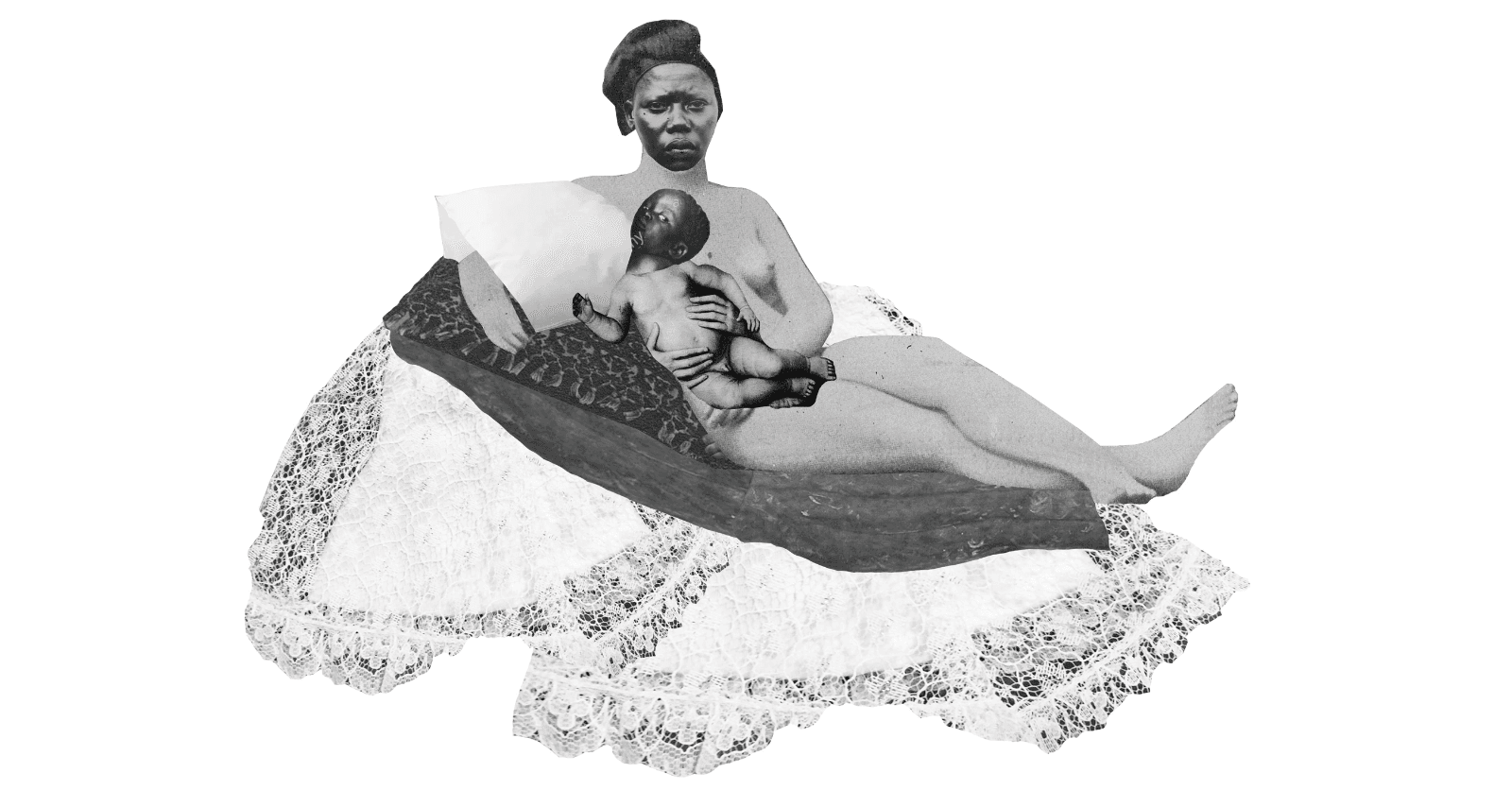

Here’s the thing about collages and their viscera, and the women who make them. The most faithful practitioners of the form are fixated on what it means to locate the grey area between reality and fabrication. They do this by means of disorder. An upright head here and then another offered like a dimorphic desirable twin. Or more drastic, a cocktail of bodies crudely refashioned into one, as if the possibilities for mixtures, for combinatorial pairings, for reconfigurations in nature are in fact limitless. To encounter a body in collage is to momentarily believe the human form is physically and even gesturally incapable of coming up against its own limitations. Frida Orupabo’s collages do this so well. They haunt the viewer with fond, familiar and unexpected shapes. Together, the forms they make are metamorphic. And ranked for what unmeasured emotion an image can evoke in its viewer, they disorient. You may resist all or most of Orupabo’s propositions.

WILD WOMEN
Seeing the female form through the Norwegian-Nigerian artist’s eyes can be jarring. A stack of black wings simply attached to a human face is offered as the fully realized body of a woman, held together with paper pins or something close. The gaze of this biform is direct, as in ‘Ehen?’ or ‘What are you looking at?’ Hardly are the girls and women that Orupabo sutures together alone by themselves with the distant, bored look of the girl in, say, La Mousmé. Whether or not they are alone though, but especially when they are alone, they look like they are waiting or steadying themselves. The air around them is often premonitory. Parts of the girl in ‘Sandwoman’ from the body of work, Things I saw at night, have evolved as if by natural selection toward superhuman, superhero-level musculature. They, Orupabo’s women, are crepuscular creatures. Their newforms realized or wrested from doing time in a world insistent on and dismissive of their private and public dystopias. In what might be her most circulated image, the aged hands of a woman—we identify in error or through social conditioning that she is a woman—hold the photograph of a young boy like a secret. The hands are veined, bejewelled, and storied.
On Instagram where I first found Orupabo who works from Oslo, she treats the photo dump as a digital lab. If the dump—with its treatment of the photographic accrual on our phones as some kind of source material from which we can pick and choose events and experiences for self-curation—is a feminine artform, Orupabo is one of its most surreal practitioners.
The artist’s use of Instagram as workspace makes a statement about the iconicity of any one image, that amounts to what might be considered a restoration of ‘the primitive status of images’. My reaction to finding my first Orupabo piece on Instagram was very much like a religious conversion. The piece, from the body of work Medicine for a Nightmare, showed a young, bare-breasted woman with scarification and a tag around her neck. She shields her vagina with one hand and holds a cigarette in another. She is kneeling. There is no sign of ecstasy on her face. When I saw it on my feed, I opened a burner account possessed by this image and once I found the language, shared it with an excerpt of Natalie Diaz’s poem, ‘These Hands, If Not Gods’:
Isn’t this what God felt when he pressed
together
the first Beloved: Everything.
Fever. Vapor. Atman. Pulsus. Finally,
a sin worth hurting for. Finally, a sweet, a
You are mine.
We know in the Sontag way, how much authority the algorithm wields in the framing of reality, especially in determining our relationship with the Black woman’s body. Even if the scope of that authority is hard to track. These apps are, after all, emergent phenomena with constantly changing features. But Orupabo’s very secular repurposing of the image produced for consumption and perception management subverts without trying. So, what if in our insistence on being photographed, we are making substitutions: less real and more curations of the self? The artist’s response to our much-recorded and much-photographed selves is to show the form of bodies as inexhaustibly strange and unknowable. Open to reconfiguration. A classic Instagram dump contains a complex signal of information: odd crops and zoom-ins, some overshare, intimations, all gesturing toward meaning making. It is not always clear which is an extension of which, even if Orupabo began to make her art online before she was included in her first gallery show. But, to go from her Instagram page to photographic representations of her collages from gallery shows, is to experience a zany immersion into the feed, into the ebb and flow of images and information.
A TRANSGRESSIVE OTHER BODY
Made mostly from an excavation of photographs recombined to form a whole, Orupabo’s collages fix the gaze, land somewhere between archetype and stereotype, but remain provisional. They suggest. If what the Sri Lankan Canadian novelist and poet, Michael Ondaatje, notes—that a good archaeologist can read a bucket of soil as if it were a complex historical novel—is true, then what a collagist does is close. A collage accretes a form and depth that equates history. It contains information: some kind of data about the monument and the history of the material. Or about the history of the artist who brings the material together.
What, for instance, does eco-depression have to do with Orupabo’s work? What is the allure of the collage to the artist? What counterpoints exist when we refuse conventional form so that the subject might dictate its urgencies, offer perspectives that require new language and new positions? What exists on the conceptual plane for Orupabo that so compels or disturbs us when we look at collages like hers? How have they become doorways through which we re-enter fractured memory, contested history, and even the war zone?
To look at any of the pieces in Orupabo’s ‘We Sleep to Wake’ published in The Paris Review Issue 239, Spring 2022, and to have grown up in a war-torn or crisis-prone place is to understand inhabitation differently. The spatial, geographical, or psychosomatic experience of fear. How it might rework the skin as an articulating surface. A way to mark the schema of some societal malaise. A way to manage public nostalgias and griefs. How the bodily form contains information about its experienced or inherited history. The specific deliriums felt in the body from being surrounded by and growing up in zones of biohazards and ecological ruin.
Comments
Sign in to comment.