Almost a decade after its first national pavilion debuted at the Venice Biennale, Nigeria returns with an ambitious eight-artist showcase. The pavilion, smart in its use of the ground space, ceiling and walls of a semi-restored Palazzo, creates new context within which we might reassess the Nigerian artefact: damaged, trafficked, or lost to the ferment of history. Replicas of stolen art coexist with sound installations that feature verse form or memoir-style narratives from poets and writers. These share space with found colonial objects, photographs of protest, imaged machinery used for exploitation and futuristic sculptures. The effect, altogether, may not be restorative—it’ll take more than two pavilions to fix history—but it amounts to a compelling start.
The appraisal of Nigerian art within the global art space has a fraught history. In a 1996 Glendora Review issue, concerned about the necessary and lopsided concessions that can become a requirement when the West shows aesthetic or acquisitive interests in the self-enunciation of the other, the curator and art historian, Chika Okeke-Agulu, questioned the reliance of art communities on this unequal union. In the decades since, depending on who you ask, it is doubtful that this relationship has become any less mystifying or that the West’s fixation with apprehending the other on its own predetermined terms has changed significantly.
For some participating countries at the Venice Biennale, the process of putting together a pavilion and selecting representative artists, influenced by controlling interests or government, reflect larger political issues or stifle creative expression and freedom. For Nigeria, a pavilion in Venice as a vehicle for national mythmaking will raise the perennial questions: who gets to make the definitive art that represents a country and what kind of geographical investment qualifies a person for the job? And if the representative artist is exiled, diasporic or of dual nationalities, it comes down to this: who has the right to yearn for a place, what place, and with what qualifications? This year, in a triumph of curatorial vision, private funding and government support, the Nigeria Pavilion faces these concerns head-on. The exhibition, put together by the British-Nigerian-British curator, Aindrea Emelife, and organized by the Museum of West African Art (MOWAA), commissioned by the government of Edo State, brings together artists who are diverse in their styles, influences, affiliations with place, and interpretations of nationhood and history.
Among them is Toyin Ojih Odutola, the Ife-born, New York-based artist, whose artistic instincts already bypass easy conceptions of place, belonging and history as questions of physical location, duration of stay, and documentation. She invites us to zoom far outside of these limiting margins to think of a city, any city at all, as place of birth, and its iconographies as ours. The lanyards by which our means of identification hang, and the fixed or changeable information contained with them as connectors to place are variable. This data, along with identifiers like skin colour and hair type, might become the rigid frameworks by which we are defined within the nation-state. And they are useful data. But for the artist, they serve only as a necessary backdrop for the more compelling and urgent matter of personal history.
ESTABLISHING THE PLOT
Ojih Odutola is drawn to structure and plot but as artifice. A way to loosely define the borders of reality. Where the focus is family lore, structure for the artist offers containment for the thousand mutinous interior lives of her subjects. Housed, the people in her canvases roam the rooms of homes where they live or visit. They loiter in its corner spaces or walk the halls and grounds of these abodes, having ventured toward solitude or privacy, however fleeting. To borrow a line from the poet, E.J. Koh, ‘they wander…numerously.’
Where the focus shifts to landscape or place, what is serious, what the people in the drawings must negotiate in their daily lives, are not necessarily wall art or the specific vegetation or grey wasps and pale newts that form their ecosystem. These are not always absolutes or formative. In consideration of the objects that surround her subjects, objects or status props that might offer some clue into who they are, the artist may concede on fabric colour and pattern, or place in our sightlines a single leaf hiding in plain sight, tattooed into the skin of her subject. But the room itself will occasionally be bland. It could be any room any place.
What the artist chooses to foreground, blur, render as distinct parts, or layer over are irreducible parts of a whole. She maps what she wants to be visible about biography or landscape onto the skins of her subjects. Impossible acts of superimposition by an artist whose tools are the ballpoint pen, sharpies, graphite, colour crayon, and charcoal, worked into a sinuous surface. At certain angles, this surface might look braided and at other angles, it will look underlit by a molten core. In choosing the ballpoint pen as overlay for this restless surface, the artist has thought about this duality. What she wants us to see is ‘the magic of viscous fluid’ at work. The way that it might trick the eyes, so that ‘the darkest areas, the relief-like marks, also become the lightest areas by simply changing one’s point of view,’ she told Bomb Magazine in a 2015 interview.
Ojih Odutola thinks of the subject of a drawing as inclusive of the materials that make the drawing and has
said in the past that the real subject of her work is the material and the mark-making she does. ‘The subjects are containers of these multitudes of marks and landscapes and colors,’ she notes. They, themselves, are no more real than the words that identify us on a paper ID card. They are planar surfaces on which the imagination of the artist can get to work unrestricted by ‘social code, aesthetic rule or formal standard.’ And we are invited into these conditions created by the artist to (her words) lose ourselves. Here, before the work, we are given infinite time and space to think. The notion of the material as made strange by the imagination of the artist so that it can transcend its banal appearance and realize its essence came to Ojih Odutola by way of the British painter and master of portraiture, Lucian Freud.
An encounter with a 1985 self-portrait of Freud made her go, ‘Dude, I’m a painter.’ An epiphanic moment that led the artist to reconsider the tools at her disposal as urgent mediums by which her subjects would be realized. She went to work with the focus of an archer, chasing not quite the authentic image of the immigrant in-betweener defined by their roots and dislocation and ailments. True, her subjects embody these things. But what they contain are conditions that are harder to pinpoint: the expanses they have traversed, the mysteries of houses, the aboutness of places. They ‘wander determined.’ The plain subject represented without this necessary refraction is not the point for the artist. It’s more the alchemic charge that happens between the looking and the translation of what is seen that is reality.
THE ARTIST VERSUS THE IMAGINARY
It is fitting then that Ojih Odutola is one of eight artists drawn from Nigeria and its diaspora to show works as part of the Nigeria Pavilion at the 60th Venice Biennale under the theme, Nigeria Imaginary. For the Biennale, Ojih Odutola turns to the Mbari House, a historic centrepiece of Igbo culture and, in its modern usage, an incubator/conservatory in post-independence Nigeria, where vibrant salons were held by the Nigerian literati. In Igbo mythology, the Mbari House is a shrine gallery built to appease the primary deities of a pantheon. Ala being the highest Alusi (deity) in the Igbo pantheon, responsible for the earth, morality, fertility and creativity. The Mbari House is open-sided and square-shaped. Large enough to hold representational figures (often life-sized and painted) of minor and major deities, ancestors, creatures of legend, colonial actors within a community and animals within its structure. Ojih Odutola’s stated interest in the Mbari House is its place as a ‘center of creative exuberance in post-independence Nigeria.’ But both forms work as interpretations of the artist’s focus.
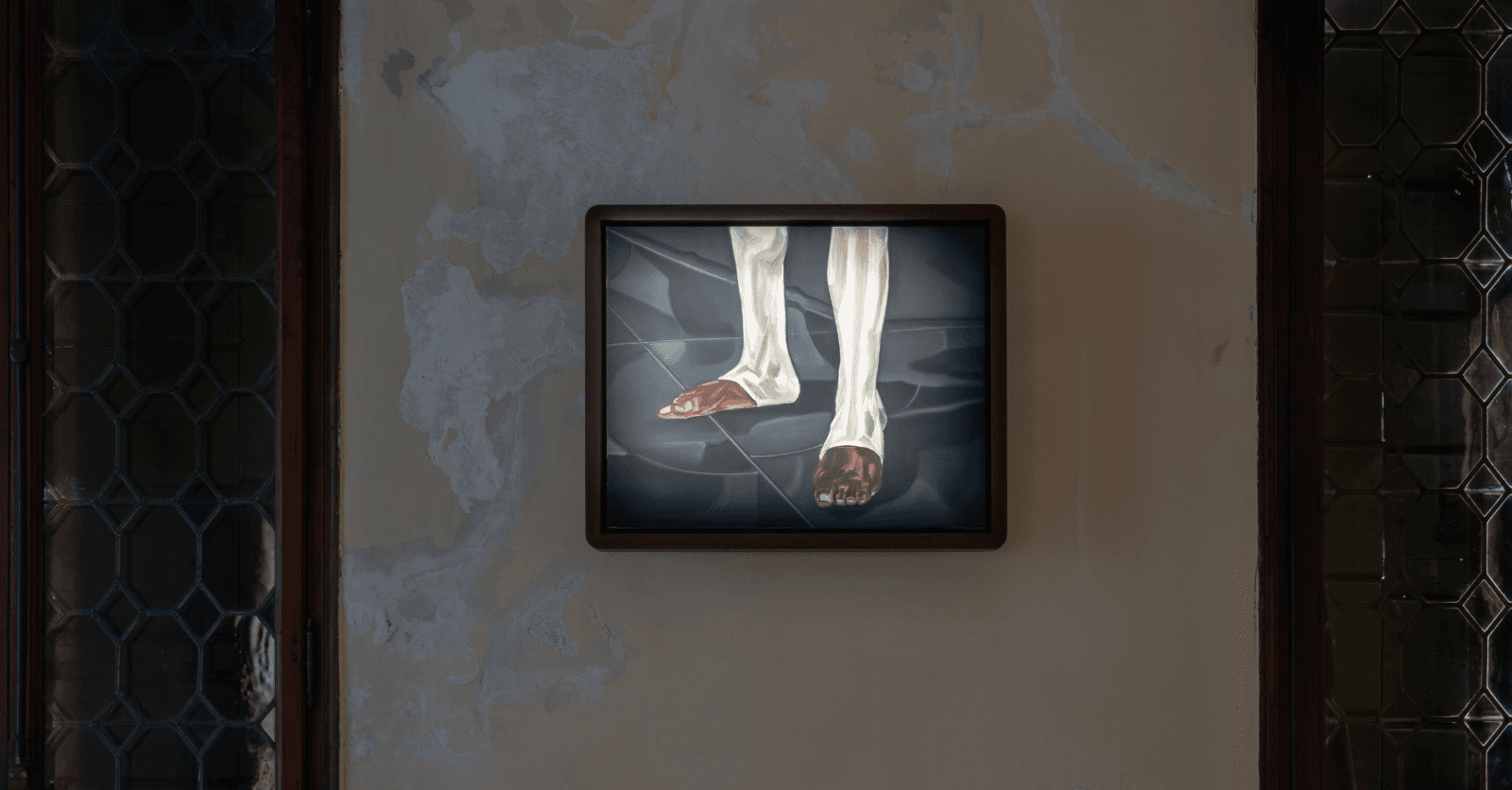
For the pavilion, Ojih Odutola envisions Ààlà’s (Ala’s) entry point into earth as through an accidental portal. Ojih Odutola’s earth is not quite the fixed plane where human life must unfold within an ecological environment and with contractual social systems. But a coincidence: any number of creation accidents or mischief may have led to the formation of this patch of land and portal. The artist measures time on a mythic scale and her heroes or representational figures are women from key events in recent history or mythology.







Comments
Sign in to comment.