On a December evening in 2024, outside Terra Kulture in Victoria Island, Lagos, young people are scattered across the scene. Lights dot the area, but not completely, so in some corners, red lights are seen with people smoking. I stayed here for a bit, watching as young people went into the building and others came out. Walking inside, the visual branding of the artist named Llona came into view: colourful rip-outs, mostly yellow and grey. Ticketers scanned the barcode on my mail, and I was soon walking on the red carpet and towards the main event arena. The stickers on the wall of the red carpet were designed flamboyantly, with an animated Llona sitting amidst the titles from the album, all written in cursive fonts.
Just before one reached the main arena, there was a small-sized cutout of Llona which held a sign that said, ‘COMMANDERS THIS WAY’ and an arrow pointing forward. With exquisite red lighting illuminating the path, a subtle sense of impressiveness passed through me, a nod for the experiential competence of what was being called ‘The HOMELESS Experience’.
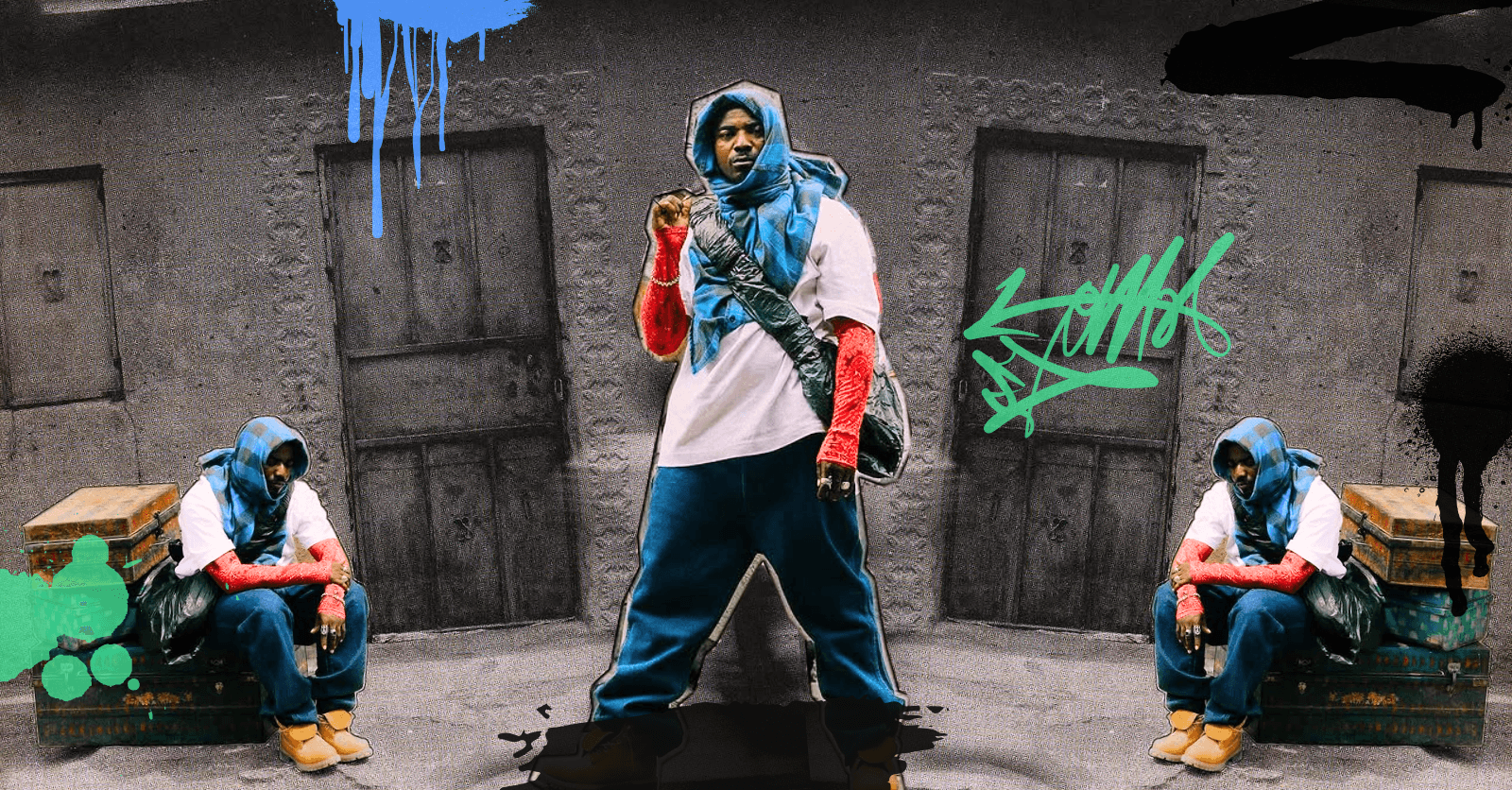
For much of the year, Llona has been in a constant state of motion. Beyond the Homeless album title, his team has pushed to solidify his standing among his peers. This has been achieved mostly through a vivid encapsulation of the musician’s stories, the people and places, especially, that has shaped him. When he began appearing in interviews, one could tell that Llona had intimate knowledge of his artistic material. Born Attah Michael Ajuma, he readily spoke of familial struggles and personal challenges, both of which are elements of the characteristic that bear into his worldbuilding.
Going into Terra Kulture that evening, an epic atmosphere was realized from the art-centric depiction, whose superhero allusions couldn’t be missed. Though it is a humane album, Homeless also thrives in this sort of aura-drenched optimism about the wider world, and one could sense that my fellow concertgoers had a feeling for that brilliant audio-visual experience.
Inside the concert arena, not far from me, a young man with full hair held his phone close to his face, the enthusiasm bare. Like the others in the arena, he wanted to keep this experience forever, but even that momentary lapse into consumerist selfishness didn’t taint the purity of the feeling. I, too, couldn’t resist keeping some part of the artist for myself, which was a testament to how magnetic he appeared on that stage. Llona’s first outfit was a white singlet, fitting, but not tight, on his almost stocky frame. He’s an imposing figure, made even more imposing with the shape of his beard, a focused lushness that runs from his underlip to his jaw and wearing a goth-evoking neckpiece, a silk black band on his left forearm and baggy jeans.
Music enthusiasts are influenced by sight as much as by hearing. The atom of pop music is visual seduction, and for several generations, the greatest pop stars are those who have understood the potential of cultivating sight. Depending on the music being created, the visual archetypes are tailored towards, such as one sees when thinking about the greats: Fela Kuti’s slender poise in those exquisite trads; the glitter and grace of Michael Jackson’s blazers. Across contemporary Nigerian music, the consensus amongst insiders is that the alte scene has offered the most poignant inspiration to mainstream pop fashion, an opinion that might be reiterated by the striking visuals behind Llona’s breakout year.
A cursory glance at the audience that Thursday night revealed young people who could have easily been at an Odunsi (The Engine) show or a Lady Donli one, carefree in their carriage and rocking the sort of dressing represented by the blooming subculture, no doubt encouraged by Llona’s own presentation. For an artist whose music consisted of strong lyrical messaging, an earnest outlook of the world, such purposeful branding was important, as people needed to put a face to the man.







Comments
Sign in to comment.