

Our new print issue, Africa’s Hustle Republics, is here! Subscribe for less than ₦1K/$1 a week for full access.
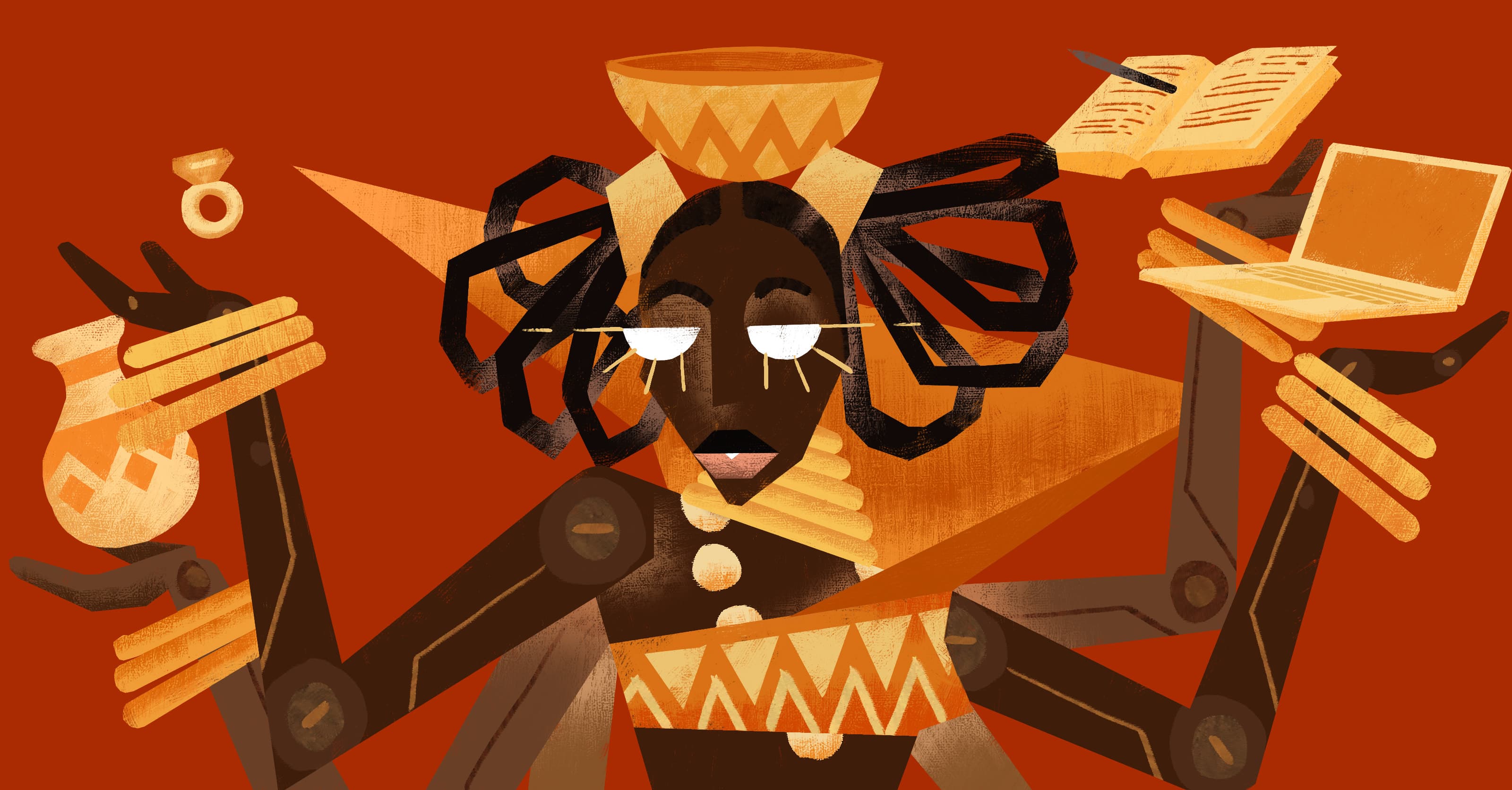
Nnedi Okorafor's 'Death of the Author' is significant in imparting agency to its Black readers who want to explore africanfuturism, redefining Black scholarship through science fiction and proving that scientific development does not exclusively lie outside literature or within Western countries.
Illustration by Charles Owen / THE REPUBLIC.
Death of the Author (2025) by Nnedi Okorafor is a novel that crosses genres—metafiction, literary fiction and science fiction (africanfuturism) all wrapped up in one piece of work. Presenting a book-within-a-book narrative, Death of the Author is about Zelu, a disabled Nigerian-American woman who seeks to make a breakthrough in her writing career while dealing with her outcast position within her family. Zelu has an unrewarding job as a creative writing professor and deals with a constant familial pressure to get married. At the lowest point in her life—with no job, no marriage prospects and a book that has been rejected several times by publishers—Zelu pens another book, Rusted Robots, that skyrockets her into fame overnight.
Death of the Author’s blurb refers to Zelu’s book, Rusted Robots, as a ‘far-future epic where androids and AI rage war in the grown-over ruins of human civilization.’ However, after Rusted Robots is published, Zelu is forced to navigate several situations that come with gaining literary stardom: an overwhelming online presence, her influence as an author, the generosity and life-changing opportunities from white billionaires, backlash about ableism when she dons on prosthetic legs, a whitewashed movie adaptation of her novel, almost getting kidnapped in Nigeria and the pressure to write a sequel. She additionally deals with personal situations that further complicate her life: her father’s death, getting married and travelling to space while pregnant.
The Republic is a Nigerian media-tech company dedicated to explaining our time—through deeply reported journalism on power, culture and society.
Focused consumption without interruptions.
Years of reporting at your fingertips.
Long-form journalism that matters.
Create a free account to continue reading this month and access more of our work.
About the Author
is a graduate student of English at the University of British Columbia Okanagan.


Comments
Sign in to comment.