

Our new print issue, Africa’s Hustle Republics, is here! Subscribe for less than ₦1K/$1 a week for full access.
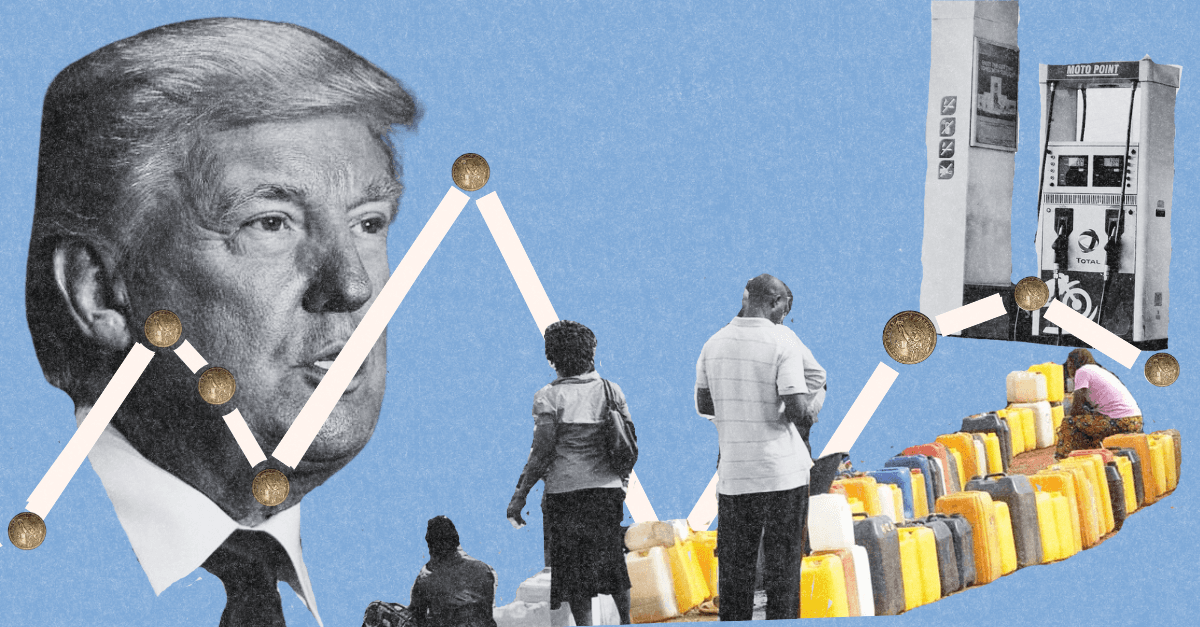
President Donald Trump’s tariff strategy and push to recalibrate the dollar has affected global capital flows, especially economies tethered to the dollar system.
Aug 17, 2025
Photo Illustration by Ezinne Osueke / THE REPUBLIC. Source Ref: WIKIMEDIA.
Photo Illustration by Ezinne Osueke / THE REPUBLIC. Source Ref: WIKIMEDIA
In global trade circles, American president Donald Trump administration’s renewed tariff campaign is being framed not merely as a revival of trade war tactics, reminiscent of the famous Richard Nixon shock of 1971, but as a diplomatic lever to recalibrate the global economic architecture. As in 1971, the tariffs are intended to bring counterparties to the negotiating table. However, where they differ is that Trump’s demands appear to go beyond currency revaluations—the hallmark of the Nixon shock—and instead pursue varied agendas depending on the counterparty.
For instance, in the case of the European Union, it is quite evident that the tariffs are a direct response to antitrust laws targeting American tech companies. During a May 2025 news conference addressing his new tariff policy, President Trump even asserted that the European Union is ‘nastier than China,’ citing EU antitrust actions against American tech firms as evidence of unfair trade practices.
As such, these tariffs are not just about traditional trade imbalances. They also concern digital taxes, maintaining capital account surpluses via deregulating antitrust enforcement, and the broader contest over control of the global tech narrative.
At the heart of it all lies an audacious move that could have lasting significance, similar to the Nixon shock. Yet, where Nixon abandoned the gold standard to preserve America’s monetary sovereignty, Trump is trying something arguably more complex. He wants to maintain the United States’ dominance in global capital markets while also reducing the trade deficit. The irony is that since the end of the Bretton Woods system in 1973, the US has run large trade deficits but offset them with capital account surpluses. In plain terms, the US buys more from the world than it sells, but the dollars it sends out come back into its economy as investments in US assets. This flow of global savings into US financial markets helped deepen Wall Street and gave rise to the dominance of American tech and finance.

The Republic is a Nigerian media-tech company dedicated to explaining our time—through deeply reported journalism on power, culture and society.
Focused consumption without interruptions.
Years of reporting at your fingertips.
Long-form journalism that matters.
Create a free account to continue reading this month and access more of our work.
About the Author
is a research political economist, poet and anthropology enthusiast.


Comments
Sign in to comment.