

Our new print issue, Africa’s Hustle Republics, is here! Subscribe for less than ₦1K/$1 a week for full access.
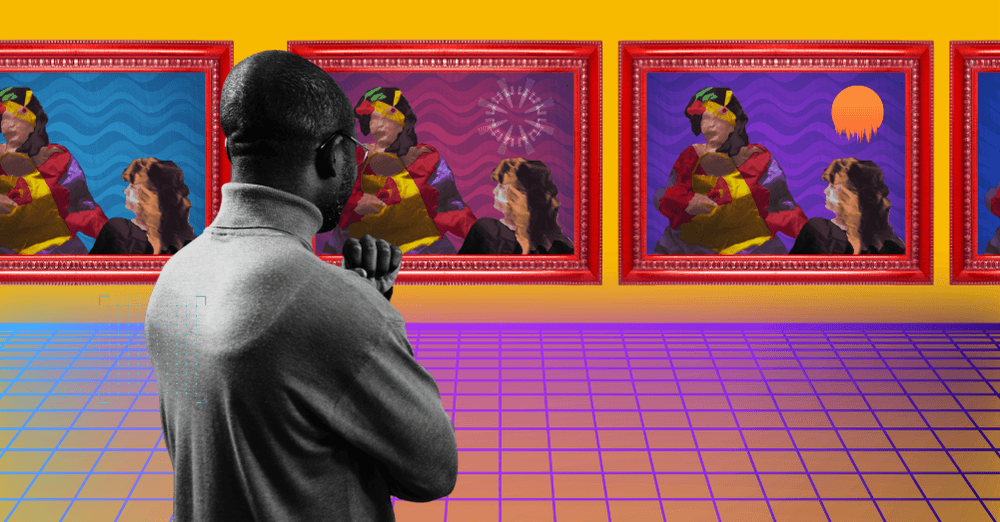
The growth of generative AI has led to debates about its acceptability in art and whether artists are being conservative for rejecting its use.
Century after century, new artistic media emerge that are initially rejected, denounced or met with resistance. In 1839, after Louis Daguerre invented the daguerreotype, the first photographic process that allowed people to capture highly detailed, permanent pictures, French painter Paul Delaroche declared: ‘From today, painting is dead!’ Likewise, Charles Baudelaire, a notable art critic of the time, called photography a ‘refuge of failed painters’ and a ‘mortal enemy’ of art. Silent films from the 19th century were seen as crude or gimmicky, the elite dismissed them as lowbrow, and theatre critics argued that they lacked the depth of stage drama. History is filled with conservatism against new media. It is therefore no surprise that, since 2015, when early experiments with Google’s DeepDream emerged, Generative AI art has faced severe criticism in the same way, with many labelling it as kitsch, and calling it mere ‘filter effects’.
The initial argument against the use of AI in artmaking stems from distrust in its ability to produce anything of artistic merit. It is fundamentally not considered a medium that is ‘enough’ in itself. This is because it depends on algorithms trained on existing human-made art, pulling from different sources to make its own. It is derivative, remixing patterns rather than expressing its own original intent. It is often criticized for enabling forgeries, deepfakes, and culturally insensitive content. It lacks emotional depth, artistic authenticity, and the personal, lived experiences that make art evocative and verisimilitudinous. In a 2025 article for Vulture, Pulitzer Prize-winning critic and AI-sceptic, Jerry Saltz, remarks distastefully: ‘I can say that 90 per cent of AI art is going to be shite, and I know that is going to be true before it even happens.’
The Republic is a Nigerian media-tech company dedicated to explaining our time—through deeply reported journalism on power, culture and society.
Focused consumption without interruptions.
Years of reporting at your fingertips.
Long-form journalism that matters.
This story features in our print issue, 'An African Manual For Debugging Empire'.
Create a free account to continue reading this month and access more of our work.
About the Author
is a Nigerian visual artist. He holds an MFA in painting from the Rhode Island School of Design, where he was inducted into the Society of Presidential Fellows. His first artist book, Inverted Blackness, was published by AFIKARIS Gallery Press in 2024.


Comments
Sign in to comment.