This story appears in our print issue, ‘
Nigeria in the World’
. Buy here. he first rain of the Savannah summer began in the city of Bulawayo as a cajoling drizzle. It pattered the soil in puckish applause. The soil, red and wet, perfumed the air. The Jacarandas unfisted their panicles, which sashayed to the ground in decay. The flowers were crushed underfoot by the frenzy of rushing feet. Youths, pimpled by lust, shuffled in bread queues and mealie-meal queues and queues for god-knows-what, stomping the ground and panting misty breaths.
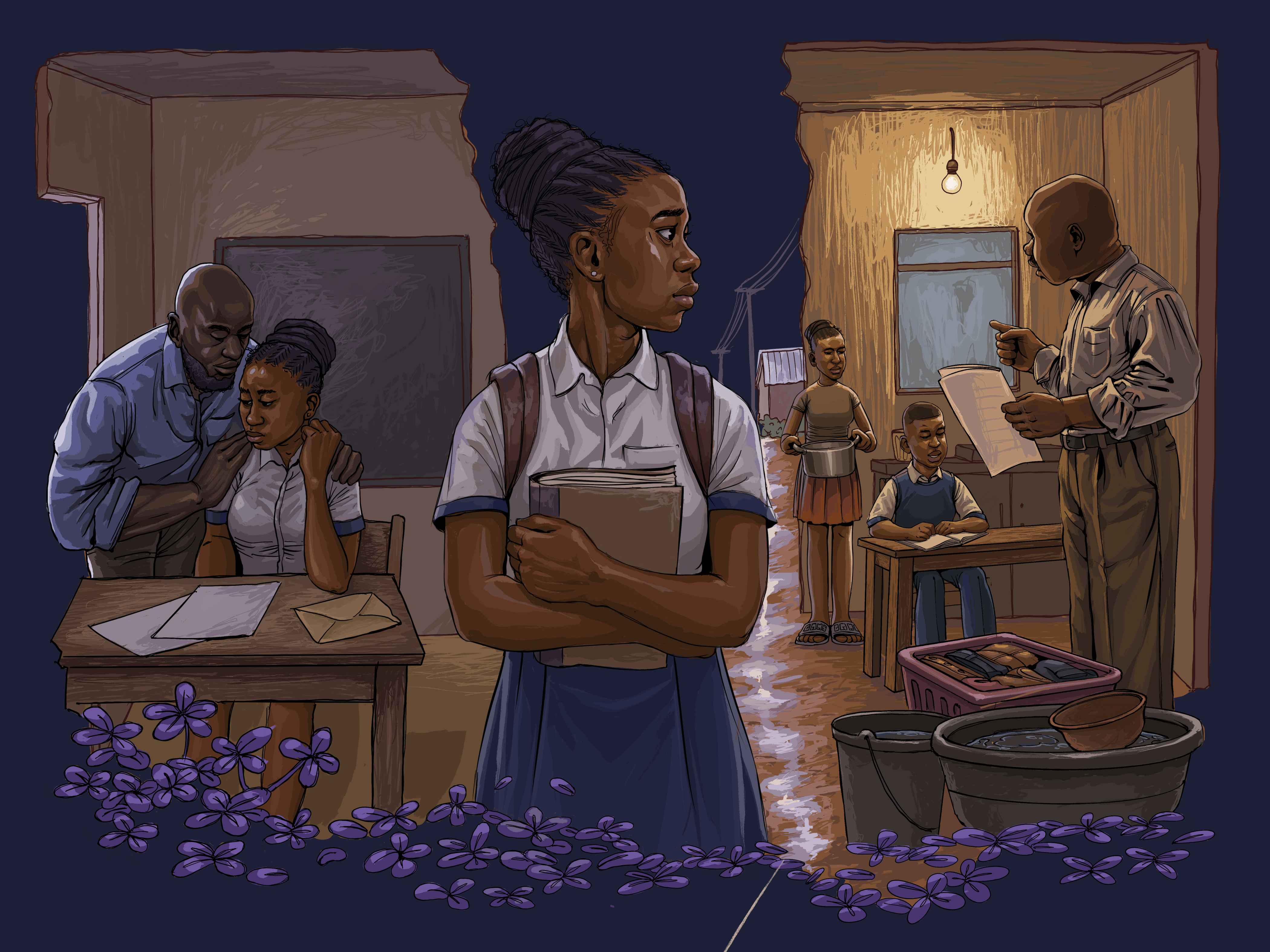
Unathi found herself in one such poise, inflamed by Freudian fever, her legs parted on a shuddering desk in a storeroom at the back of a classroom in Siphithiphithi High. Hers was a salacious hope, built upon the democratic dreams of one-man, one-vote but more importantly, having her own voice heard. The desk shuddered with Luckmore. He sighed, pulled away, and bent to pull up the trousers bunched around his ankles. Unathi brought her legs together. She stared at him.
Ever since the dashing new physics teacher had joined the township school, the form four girls had taken to clumping together in the corridors, breaking into juvenile giggles whenever he sauntered past, asking to pat his afro or try on his rimless spectacles. What it was, really, they agreed, was his nose. Such a nose—pompous, prominent—would look ugly on a lesser man. But there was something about the young teacher’s face that gave him a certain into-leyana, like a man who knew how to do. And out of all the girls in form four, he had chosen her, seventeen-year-old Unathi—gangly legged, with only slight mounds for breasts and a pimply face—for his affections.
She tittered. ‘Tell me about America,’ she said, watching as the young teacher looked about him, as though noticing, for the first time, the test papers strewn across the floor.
‘Always, you want me to tell you the same things over and over,’ he said, his eyes still on the floor.
‘Yes,’ she said. ‘Tell me. Tell me how it’s an impressive me-tro-police. Tell me how when you look up to see where the sky-scrapers end, you can feel the back of your neck straining from the effort.’
‘Don’t you think you should go?’ said Luckmore, and then, peering about, though the storeroom had no window, ‘It’s getting late.’
Do you love me? Unathi wanted to ask. Instead, she pouted and held out her hand. ‘Paper.’
Swearing under his breath, Luckmore bent and began scooping up the papers, turning over each paper before letting it fall back on the ground.
Unathi patted the creases of her uniform. Still, it remained crumpled. ‘I’ll be in for the belt tonight.’
‘Oright, oright, juss a minute,’ said Luckmore.
He handed her the test paper, his gaze averted still. She folded it, stuffed it into her satchel, and made for the door.
‘I’ll see you tomorrow?’ she said, hopefully.
He nodded. ‘Yes, yes, I’m supervising the Physics exam tomorrow.’
She winced. He began busying himself with the mess on his desk. She turned and left, without so much as a mcwah on the cheek.
Outside, it had stopped raining. The air was youthful with energy. It hung restless over the box-shaped houses of Luveve 5, framed by a damp, dying light. Into this early evening light came the township children, ticklish with the last glimmers of sun, and began wriggling their buttocks to the state jingles of their times.
Tony Blair! they cried to the ditty blaring from their fathers’ radios, The Blair-ya that I knowuuu is a toi-le-tee! Tony Blair! The Blair-ya that I knowuuu is a toi-le-tee!
And just like that, the Blair toilet—that pit-latrine in which the peasantry shat, named after some Blair somebody from a shitty, bygone era—became the buttock of township buffoonery.
Unathi slung her satchel across one shoulder and marched down the road, swatting her way through the dancing children. She wondered what Luckmore was doing now. Was she running through his mind, tiring him the way he did her? Her heart sank when she saw the Peugeot parked in their yard. She opened the gate slowly, but it still made a grating, squeaking sound. She imagined Baba in the sitting room in front of the TV, watching her through the window as she slunk in with the dusk.
Better to go in through the back. But it was no use; as soon as she stepped inside, she heard Baba barking her name.
Light spilled from the kitchen and receded into the dark passageway. Unathi caught sight of the exaggerated shadow of her mama on the wall, stirring a pot that stretched eerily along the floor. The aroma of Royco filled the house. She hurried through the kitchen to the sitting room, her satchel still slung over her shoulders.
She crouched by the nearest sofa in the sitting room, facing her father. He was slouched in his sofa across from her, his belly protruding beneath his favourite shirt, the one with the black-and-white shield sewn on the left breast pocket. Mbonisi sat opposite him, squirming, in a matching shirt.
Unathi’s face lit up. ‘Did Highlanders play today?’ she asked.
‘The day you think you are a grown woman,’ said Baba. ‘You will move out of my house.’
‘We had extra lessons for the exams—’
‘If you think you are now a woman, leave my house!’
Unathi smiled and fixed her eyes to the floor. She tried not to think of Luckmore, the way he had held her, their faces almost touching. ‘Yes, Baba.’





Comments
Sign in to comment.