‘I Want My Writing to Sound on Paper How It Sounds in My Head and Heart’
Academic and author of The Theology of Mercy Amba Oduyoye: Ecumenism, Feminism, and Communal Practice, Oluwatomisin Olayinka Oredein, tends to pay less attention to books that fail to enhance her work: ‘I would leave behind any book that denies the diverse richness of African perspectives and various forms of Blackness, that relegates Christianity to Western forms, and that tries to suffocate the poetic and its expressive reach.’
By Oluwatomisin Oredein
February 27, 2024
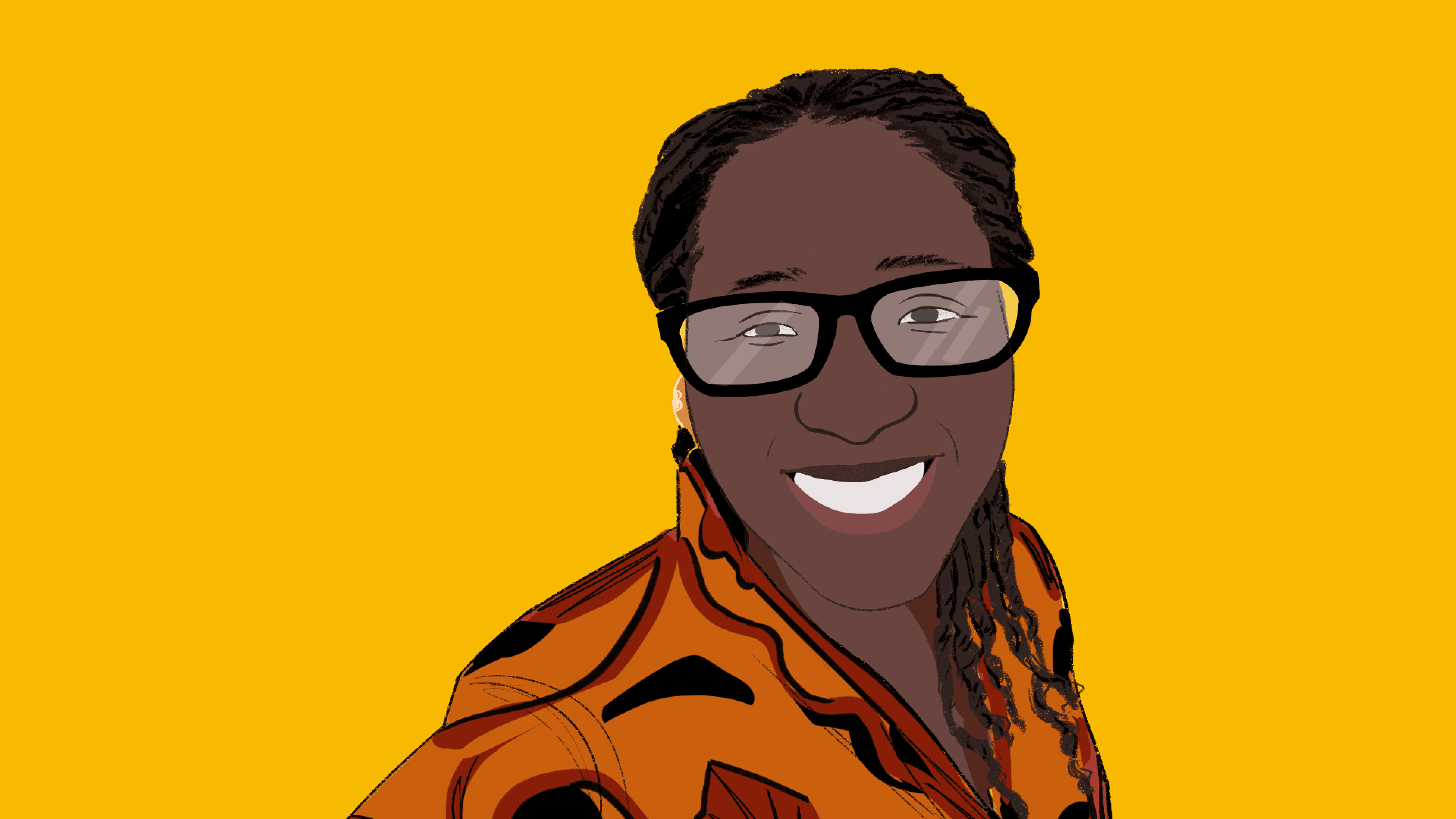
Oluwatomisin Olayinka Oredein. Illustration by Kevwe Ogini.
Editor’s note: This essay is available in our print issue,
An African Feminist Manifesto. Buy the issue
here.
First Draft is our interview column, featuring authors and other prominent figures on books, reading, and writing.
Our questions are italicized.
What books or kinds of books did you read growing up?
As someone who identifies as Nigerian-American, growing up in the US, I loved reading American mystery books! There was something about the problem-solving inclinations, the cleverness, and the attention to detail in these books that resonated with who I was: someone who was always trying to solve something about my own life or about what was happening in the life (internal and external) of another. Though I felt pressure to read classic literature such as
Of Mice and Men,
The Great Gatsby,
Moby Dick, the
Illiad, or any and all Shakespeare in order to be considered a ‘proper’ student of English, I could never convince myself to engage books, literature, and poetry that did not first draw me to itself. In my teenage years, I also felt compelled to read books about Black girls, books that even if I did not understand them completely, I could sense were important to my development, such as Toni Morrison’s
The Bluest Eye.
In your earliest days as a theology student, what books were foundational to your study and research?
Late in my divinity school education was when I was recommended the work of Ghanaian women’s theologian, Mercy Amba Oduyoye. She inevitably became the subject of my first book. It was in her work—I first met her through her 1995 book,
Daughters of Anowa, and found myself reading and re-reading her critical work,
Introduction to African Women’s Theology, constantly—that I saw how I could bridge my Nigerian and American identity within my scholastic interests.
“In my teenage years, I also felt compelled to read books about Black girls, books that even if I did not understand them completely, I could sense were important to my development.

What’s the last thing you read that changed your mind about something?Reading Nayyirah Waheed’s newest creation, a multibook,
Stream Black Books, has inspired me to contemplate Blackness, spirituality, creative inheritances, cultural beliefs together, and towards what directions they can push areas like Christian theology and ethics. I am convinced that Christian theology in the West must take various Black spiritual expressions and forms seriously in order to best understand its own history and legacy. Waheed’s creation invites this exploration and much, much more!
Stream Black Books (actively) shatters my understanding of who I thought could be my theological conversation partners and expands my view of the divine.
What is the last book/text you disagreed with, and why?
Honestly, any Christian theological or ethical work, especially if Western or Western-adjacent, that tries to universalize rigid and harmful claims and ideas without considering the multiplicity of cultures, and frankly, Christianities that stem from them, will likely not be helpful in any work that I aim to do.
To write The Theology of Mercy Amba Oduyoye, I read everything Aunty Mercy wrote that I could access—from her books to her chapter contributions to her long and short articles. I also attended or watched talks and lectures she offered at various conferences. I had to let her voice be the primary one talking about her life and theological perspective. I further gathered her self-proclaimed stories and read the stories about her from others. I conducted a formal interview with Aunty Mercy and had a few informal conversations with her. In these conversations, I paid attention to the stories she told. Again, for me, her first-person accounts were most critical in writing this book well. I, lastly, read everything I could acquire that other scholars have written about Aunty Mercy to ensure I got the most holistic picture of her life, her reach, and the impact of her work.
Why was it important that you wrote this book?
I wrote this book because no one has written a monograph on Aunty Mercy besides Aunty herself. There are works that honour her, but not one that offers an objective look at her life, her formation, and how they colour how she sees and interacts with the divine. I wanted to offer my theological elder respect as well as converse with her insight and ideas. In my book, I get the honour to do so.
What books did you read while you were working on The Theology of Mercy Amba Oduyoye?
I read Aunty Mercy’s books and books she is featured in, including but not limited to:
“I entered divinity school knowing that I had questions about the Christian faith, especially from my identity as Nigerian-American.
You’re a professor of Black religious traditions, constructive theology, and ethics. What books do you recommend to students who take your class?
A few books I recommend are:
The Oxford Handbook of African American Theology, edited by Katie Geneva Cannon and Anthony Pinn;
Stony the Road We Trod: African American Biblical Interpretation by Cain Hope Felder;
Bitter the Chastening Rod: Africana Biblical Interpretation after Stony the Road We Trod in the Age of BLM, SayHerName, and MeToo, edited by Mitzi Smith, Angela Parker, et. al;
Womanist Theological Ethics: A Reader, edited by Katie G. Cannon, Emilie Townes, et. al;
Constructive Theology: A Contemporary Approach to Classical Themes, edited by Serene Jones and Paul Lakeland;
Theology Brewed in an African Pot by A. E. Orobator;
Olodumare: God in Yoruba Belief by E. Bolaji Idowu; and
The Palgrave Handbook of African Social Ethics, edited by Nami Wariboko and Toyin Falola.
Which books about Black religious traditions should everyone have on their bookshelf?
Comments
Sign in to comment.