‘I Am Drawn to Stories That Tackle Complicated Family Relationships’
Ghanaian writer and author of Blue: A History of the Color as Deep as the Sea and as Wide as the Sky , Nana Ekua Brew-Hammond, says her children’s book was inspired by a Bible passage about the furnishings in King Solomon’s temple.
By Nana Ekua Brew-Hammond
March 29, 2024
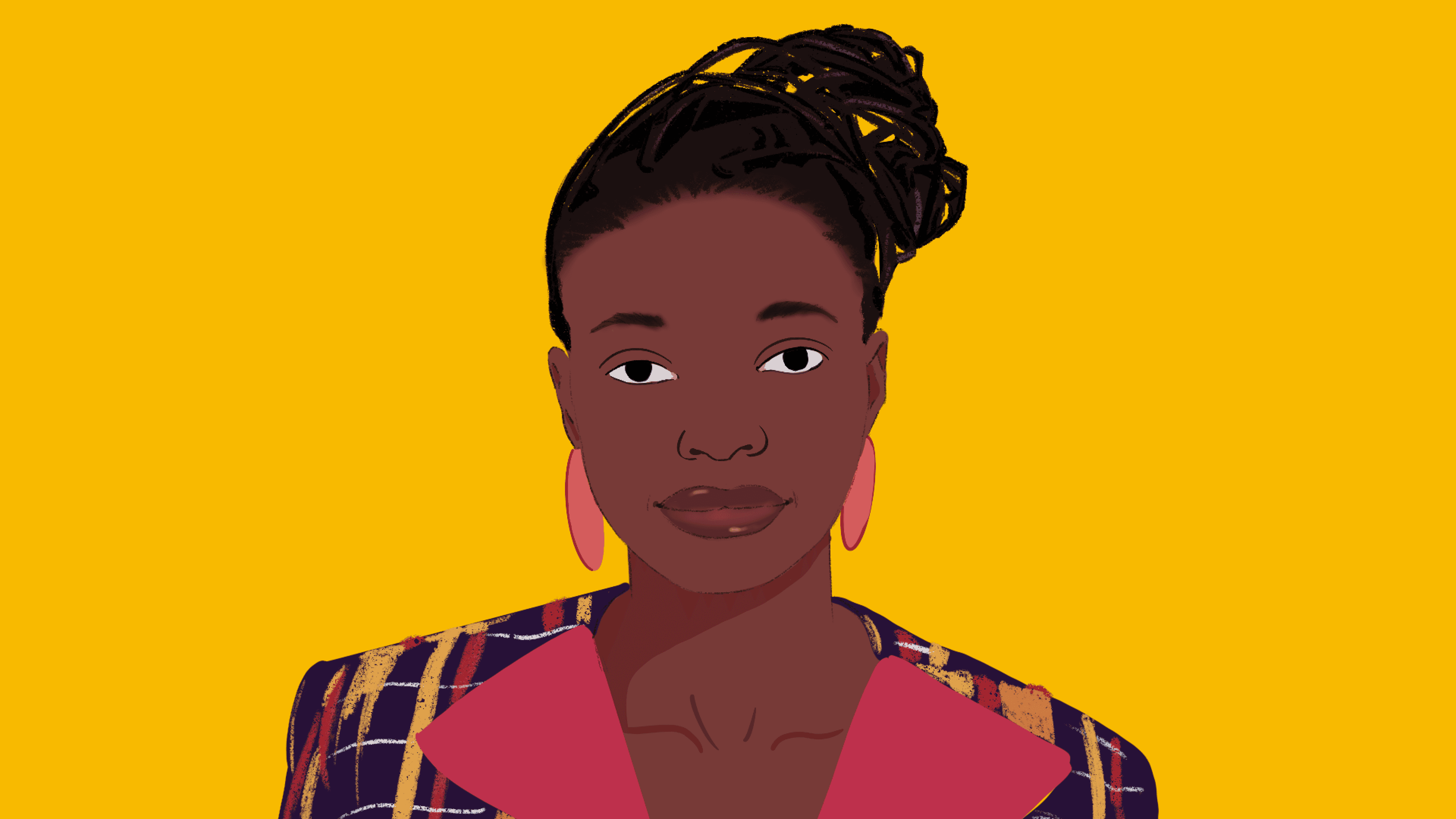
Nana Ekua Brew-Hammond. Illustration by Kevwe Ogini.
First Draft is our interview column, featuring authors and other prominent figures on books, reading, and writing.
Our questions are italicized.
What books or kinds of books did you read growing up?
My dad had me reading from age three, so after I devoured the fairytales and chapter books in our bookcase, I moved on to adult fare. By the time I was ten, I would be off in a corner of my school playground devouring one of Sidney Sheldon’s fast-paced dramas or a multigenerational Judith Krantz epic. I read them alongside series like Carolyn Keene’s
Nancy Drew, Francine Pascal’s
Sweet Valley High, and Brenda Wilkinson’s
Ludell. Even though my dad would recite Kweku Ananse stories, and we had Ayi Kwei Armah and Kwame Nkrumah on our shelves in New York, it was when my parents sent me to live and school in Ghana at age twelve that I started reading literature by African writers.
Ama Ata Aidoo’s play,
Dilemma of a Ghost, made me realize how hungry I was for more stories about Black people, and about anyone navigating life and identity between multiple cultures.
If your life at this moment was the chapter of a book, which book (fiction or non-fiction) would that be?
Right now, my life feels like a chapter in Michelle Obama’s
Becoming. After a decade of rejection, I’ve had three books published in three years. All at once, I am experiencing the exhilaration of change and the awkward fragility of transition.
What’s the last thing you read and disagreed with?
I read an essay about the British royal family which trafficked in tired tropes that beatified one family member and dragged the other. It was already one opinion too many in a rabbit hole of headlines I allowed myself to fall into. The outlet got their click, and I can’t reclaim the time or energy I spent feeling mildly irritated about individuals whom I empathize with as humans, despite having no reason to know so much about them simply because they are associated with an institution I don’t support.
“By the time I was ten, I would be off in a corner of my school playground devouring one of Sidney Sheldon’s fast-paced dramas or a multigenerational Judith Krantz epic.
What’s the last thing you read that changed your mind about something?
Miral al-Tahawy’s
The Tent expanded my idea of how a story can and should be told. For most of this novel, set in the desert on a gated Bedouin family compound, she challenges readers accustomed to Western storytelling structures to really engage with and understand the text. Then, towards the end of the book, she has the protagonist perform her story for a British character and her friends, showing us the ways writers published in the West wittingly or unwittingly pander to European and North American sensibilities.
What is your writing process: edit as you write or draft first, then edit?
I edit as I draft, and then I edit when the manuscript is ‘done’. This process keeps me connected to the reader’s experience. Every time I go back to my draft, I read it from the beginning. If I find myself losing interest at a certain point or questioning whether a character would really say what I’ve written, I know my reader will, too.
I was reading a Bible passage about the furnishings in King Solomon’s temple and wondered why the scripture made specific note of the colour of the curtain. Why did it matter that the curtain had blue in it? Seeking the answer to that question led me to Google, then books on the history of colour, and a plethora of research papers and articles. I was so wowed by what I was learning! My sense of wonder was totally renewed. I thought to myself, ‘Kids need to know about this!’
Which book from your childhood would you pass on to someone younger?
I don’t know that I would pass on any of the books I read as a child—and not only because many of my reads weren’t age appropriate. The children’s books I did read were overwhelmingly about white children living lives that subliminally made me feel my life was insignificant or deficient. Today, even though there is still an urgent need for diversity in kids’ books, I see more books addressing a wider breadth of experiences and more channels for children and adults in their lives to access these books.
Before Blue, you had published the young adult novel, Powder Necklace. These books were written for and about younger readers. What’s a common misconception about writing for younger readers? Maybe because I read so many kinds of books when I was a kid, and I did not pursue an M.F.A., I wrote Powder Necklace and Blue without any rules or misconceptions in mind. As I’ve had the opportunity to share Blue with readers aged three and above in the US, Ghana, Trinidad, and the UK, I’ve found that children make connections to the text that meet them where they are. In the US, the youngest readers start pointing out all the blue they see. The seven- to nine-year-olds are appalled at what’s unfair and unjust in history. The ten- to twelve-year-olds want to know where I got my outfit, how many copies of the book I’ve sold, and how much money I’ve made. It’s funny and fascinating to see how their questions change as their understanding of the world develops.
“If I find myself losing interest at a certain point or questioning whether a character would really say what I’ve written, I know my reader will, too.
Your forthcoming adult fiction novel, My Parents’ Marriage, has been called a ‘profound story about love and understanding told through three generations of one Ghanaian family’. Which book/author had the most influence on your approach to writing it? I wasn’t thinking about any one book or author in my approach to writing
My Parents’ Marriage. That said, I am drawn to stories that tackle complicated family relationships, particularly marriages and mother-daughter dynamics, which is why Buchi Emecheta’s
The Joys of Motherhood, Janet Fitch’s
White Oleander, and Tayari Jones’s
An American Marriage are among my all-time favorites. It is why I chose to pitch an anthology called
Relations that ultimately centered many of those kinds of stories. I’m also deeply interested in books like James Baldwin’s
Just Above My Head that ruminate on faith and how it can impact family dynamics.
What makes a story unforgettable?
What makes a story unforgettable is how it makes you feel, and how it stands up to time. There are stories that meet you at a particular moment in your life, right when you need it, carrying you through grief, articulating your joy, or helping you make sense of your world and times in some meaningful way. You might go back to those stories later and feel differently but still love them for what they once meant to you. The stories that transcend that single moment, that keep revealing something new each time you engage them are the ones you pass on.
And what’s the greatest love story you’ve ever read?
I think the best love stories are lived out. Adam Davidson’s ten-minute short film
The Lunch Date is a good example.
Which book did you enjoy in the last year and wish more people knew about?






Comments
Sign in to comment.